Yellow leaves on a peace lily, diagnosed.
It's overwatering. Probably. Here's how to be sure — and the four other suspects.
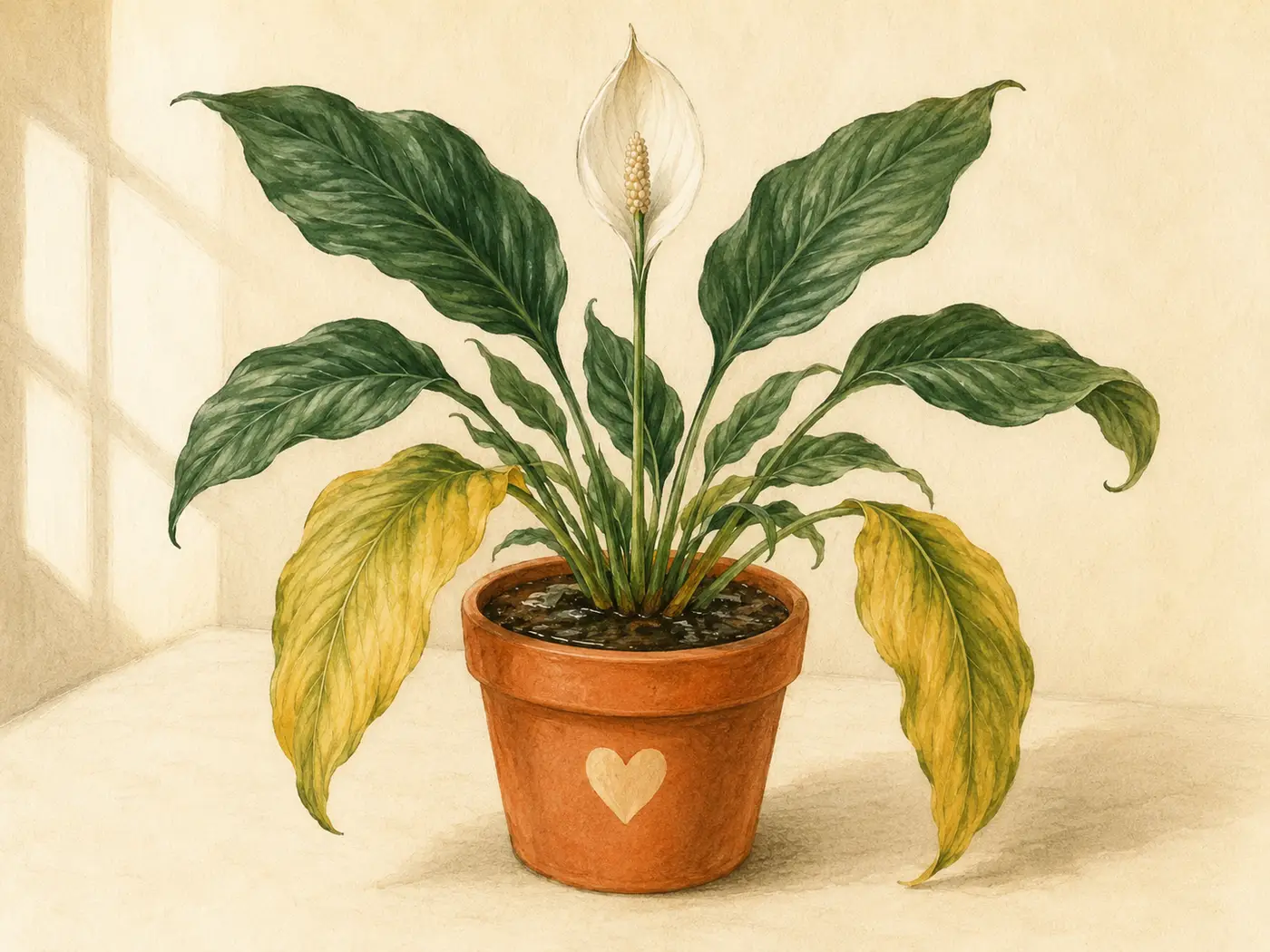
At a glance
- Top cause
- Overwatering (~70% of cases).
- Other causes
- Old age, low light, mineral burn, cold draft.
- Reversible?
- The plant recovers, but yellow leaves don't turn green again.
- Action
- Stop watering. Check the roots.
1. Overwatering (most likely)
If multiple lower leaves are yellow at once and the soil feels constantly damp, you've overwatered. Roots can't breathe in soggy soil; they suffocate, and the plant abandons leaves to conserve resources.
Fix: stop watering. Let the top two inches dry out before the next drink. If the plant doesn't recover within two weeks, suspect root rot and unpot to inspect.
The fastest clue is the pot, not the leaf. A heavy pot, wet drainage holes, a sour smell, or a saucer that keeps collecting water all point to a moisture problem. If the pot has no drainage hole, move the plant to a draining pot as soon as possible.
2. Natural aging
One yellow leaf, on the outside, on an otherwise happy plant? That's just a leaf retiring. Snip it at the base.
Natural aging usually affects the oldest outer leaf one at a time. The rest of the plant should look firm, upright, and green. If several leaves yellow together, or new leaves yellow first, treat it as a care problem.
3. Low light
Light-starved peace lilies will sacrifice their oldest leaves to feed the rest. Pale, slow-growing, never blooming → move closer to a window.
Low-light yellowing is gradual. You may also see long petioles, smaller leaves, and soil that stays wet for too many days because the plant is not using water quickly. Move the plant one step brighter, then watch the next two leaves rather than expecting yellow leaves to recover.
4. Mineral / fluoride burn
Yellowing that starts at the tip and creeps inward, often with a brown tip first, is tap-water damage. Switch to rainwater or filtered.
If you also see white crust on the soil or pot rim, flush the soil with plenty of room-temperature water and let it drain fully. Filtered, distilled, or rainwater can reduce new tip burn, but old yellowed tissue will stay yellow.
5. Cold draft
Yellow patches that turn black overnight? Check for an AC vent or a leaky window.
What to do today
- Feel the soil two inches down and lift the pot to judge weight.
- Check the leaf pattern: one old leaf, many lower leaves, tips first, or black patches.
- Empty any saucer water and pause watering if the mix is damp.
- Move the plant to bright indirect light, away from cold glass and vents.
- Remove fully yellow leaves at the base so the plant can redirect energy.
Will yellow leaves turn green again?
No. Once a peace lily leaf turns fully yellow, it will not green back up. Recovery shows through new leaves, firmer stems, and the yellowing pattern stopping. This is why diagnosis matters: the goal is not to save the yellow leaf, but to stop the next one from yellowing.
When to inspect roots
Unpot the plant if yellowing is paired with drooping in wet soil, a sour smell, black mushy stems, or soil that remains wet for more than a week. A quick root check is less risky than letting a rotting plant sit. Healthy roots are firm and pale; rotted roots are brown, soft, and may slide apart when touched.
How to prevent the next yellow leaf
Give the plant a stable routine: bright indirect light, a draining pot, and watering based on the soil rather than a calendar. Empty saucers, avoid cold drafts, and feed lightly only during active growth. Most repeated yellowing comes from one of those basics being off by a little for too long.
For the cosmetic step of removing fully yellow leaves, see the pruning guide. If the plant arrived with yellow leaves from the store, the buying guide covers what to inspect before purchase. Mineral-driven yellowing (with brown tip first) usually traces back to water quality.
Yellow leaf pattern decoder
The pattern of yellowing — which leaves, where on the leaf, and how fast — usually points to the cause faster than any single test:
| Pattern | Most likely cause | First action |
|---|---|---|
| Multiple lower leaves yellow together; soil damp; pot heavy | Overwatering / early root rot | Stop watering; unpot to inspect roots |
| One old outer leaf yellow; rest of plant healthy | Natural aging | Snip at base; ignore |
| Slow yellowing; pale new leaves; long petioles; no flowers | Low light | Move closer to a window |
| Yellow with brown crispy tip first; whitish soil crust | Mineral / fluoride burn from tap water | Switch to rain or distilled water; flush soil |
| Yellow patches turning black overnight; near a window | Cold draft | Move away from glass and AC vents |
| Yellow with sticky residue or webbing on leaves | Pests (mealybugs, spider mites) | Isolate; cleanup protocol |
| Yellow with crispy edges; recently fertilized | Fertilizer salt burn | Flush soil with 3x pot volume of water |
| Sudden mass yellowing after a move or repot | Transplant / acclimation shock | Stabilize light, water, temperature; wait 2–4 weeks |
Yellow vs other discolorations
Not every off-color leaf is "yellowing." The cause and fix are completely different depending on which one you actually have:
- Pale green new growth — usually low light or slight nitrogen deficiency, not overwatering.
- Yellow with green veins — iron or manganese chlorosis, often from alkaline tap water; a different fix from straight overwatering.
- Yellow blotches between veins — magnesium or fertilizer-related, not a watering problem.
- Yellow turning brown then black — past the saving point on that leaf; focus on stopping new yellowing.
- Bleached / whitish-yellow — sun scorch from direct light, not chlorosis.
When yellowing is normal
Mature peace lilies replace lower leaves regularly. Losing one outer leaf every couple of months on an otherwise healthy plant is part of normal aging — not a problem. The signals that aging is the cause:
- Only one leaf at a time yellows.
- It is always the outermost, oldest leaf.
- The center of the plant is firm and producing new growth.
- The pot is not waterlogged.
- The yellowing happens slowly over weeks, not days.
If all five apply, snip the leaf and forget it. Concern starts when more than one criterion fails.
How fast is the yellowing happening?
- Hours to overnight
- Almost always cold damage or shock from a sudden move. Check temperature and recent location changes.
- 1–3 days
- Active root rot, severe drought, or chemical burn (fertilizer, softened water).
- 1–2 weeks
- Ongoing overwatering, low light, or pest pressure building up.
- Weeks to months
- Mineral accumulation, slow nutrient deficiency, gradual root binding, or simply aging.
Sources & further reading
- University of Florida IFAS Extension — Spathiphyllum disease management.
- RHS plant problems database, retrieved May 2026.
- Chen, J. — Common abiotic disorders of foliage plants, ENH-Florida.