Are peace lilies toxic to dogs?
Yes — usually mild, occasionally significant. The risk depends on size and how much was eaten.
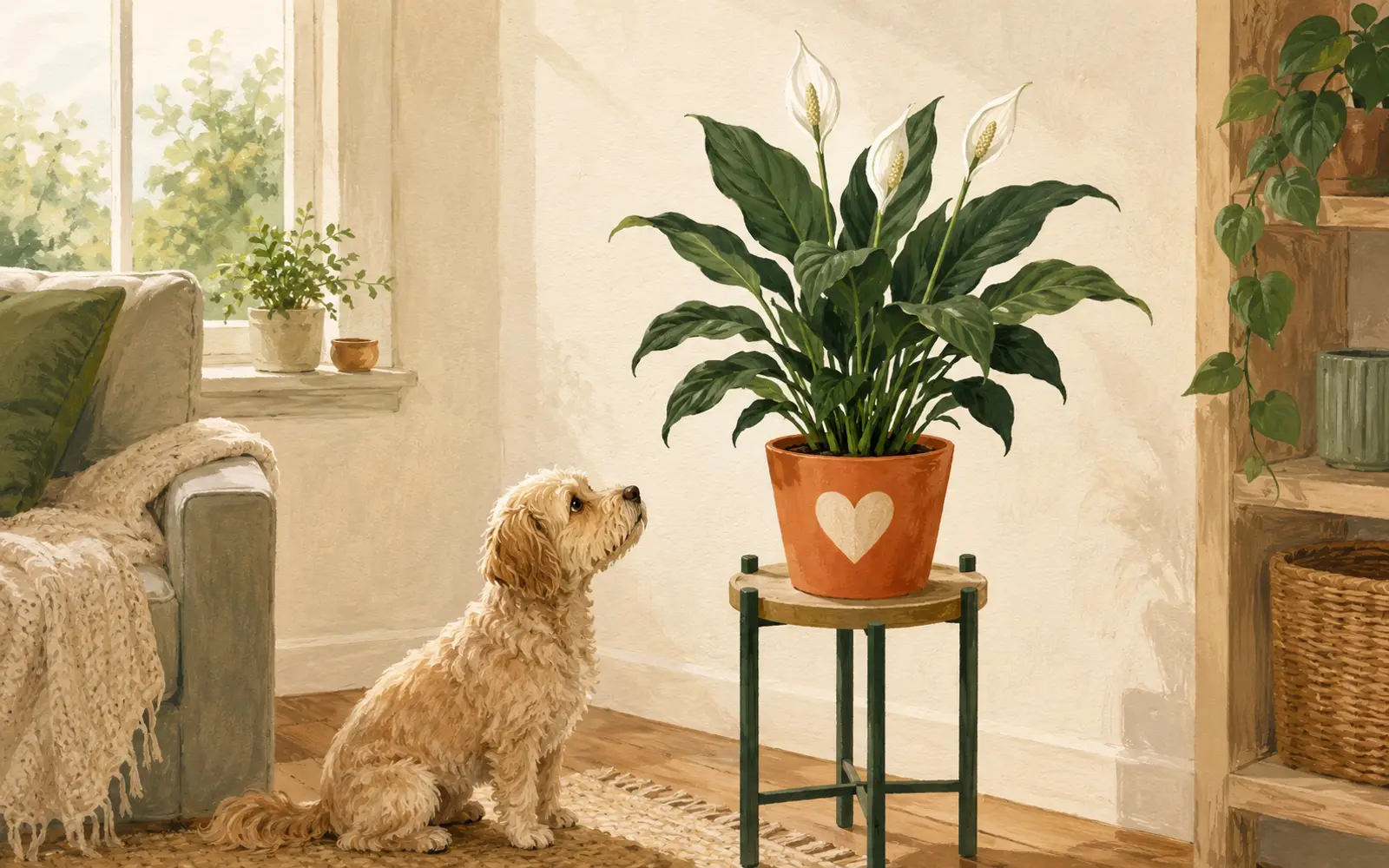
At a glance
- Toxicity to dogs
- Mild — oral irritation, rarely serious
- Mechanism
- Calcium oxalate crystals
- Highest risk group
- Puppies under 20 lb and small breed adults
- Most common scenario
- Boredom chewing or curiosity exploration
- Resolution
- Typically 2–6 hours; 1 vet call rate per ~12 home incidents
Dog size is the biggest single factor
Unlike with cats — where a single chewed petal of a true lily is a kidney emergency regardless of cat size — peace lily risk in dogs scales almost linearly with body weight versus how much was eaten. The same chewed leaf is a non-event for a 70-pound Labrador and a real concern for a 4-pound Yorkshire Terrier.
Rough triage by body weight, assuming a single moderate chewing incident:
- Under 10 lb / 4 kg: call the vet even for mild symptoms. Smaller airways, smaller fluid reserves, and faster-moving symptoms.
- 10–30 lb / 4–14 kg: watch closely for two hours. Call if symptoms worsen or persist.
- Over 30 lb / 14 kg: home monitoring is usually sufficient. Call for visible swelling, repeated vomiting, or breathing changes.
This is general guidance, not a substitute for a vet call. Dogs with heart, kidney, or airway conditions deserve a call regardless of size.
Puppies are the most common ER visitors
Adult dogs that have been around houseplants their whole life rarely chew them. Puppies under six months old are a different story: they explore with their mouths, have no learned aversion, are smaller, and often chew several leaves before the irritation registers. If you are houseplant shopping during a puppy's first year, peace lily belongs in a closed room or off the list entirely.
The same applies to newly adopted adult dogs from shelters or rural backgrounds — the first few weeks in a new home with new houseplants is when chewing happens.
Dog behaviors that make this plant riskier
Three patterns in dogs (different from the cat patterns) change the math:
- Chewing as boredom relief. A peace lily near a dog crate, a long-stay area, or the dog's morning route can become a chew toy after several days alone. Cats explore once and quit; dogs revisit.
- Soil digging. Many dogs dig the pot before they chew the leaves. Soil contains fertilizer salts and perlite that compound the problem. Mention soil ingestion when calling a vet.
- Knocking the pot over. Large dogs nose pots off low surfaces. The plant ends up on the floor, the dog ends up with the whole specimen rather than one leaf.
If your dog chewed the plant
Step-by-step first aid is shared with cats and humans on the symptoms and first aid guide — go there first if you are reading this with a dog actively drooling. The dog-specific notes below assume you have already removed plant material from the mouth and offered water.
Information that helps the vet most:
- Dog's body weight and age.
- Estimate of how much plant material is missing (hold a remaining leaf next to a damaged one if possible).
- Time of chewing if you saw it.
- Whether soil was eaten too.
- Photo of any vomited plant material.
Save these in your phone before you call: ASPCA Animal Poison Control (888-426-4435) and Pet Poison Helpline (855-764-7661). Both charge per consultation but give breed- and weight-aware advice.
Dog-proof placement
Dogs cannot climb the way cats do, which makes this easier. Effective placement:
- Tall plant stands the dog cannot reach standing on hind legs (over 5 ft for a Lab; over 7 ft for a Great Dane).
- Hanging baskets away from couches the dog jumps onto.
- Counter or high shelf in a kitchen or office where the dog does not access independently.
- Closed room the dog never enters.
Avoid: low tables, plant stands within nose reach, and floor pots in any room a puppy uses unsupervised.
Cleanup after pruning
The most-overlooked exposure is fallen or pruned leaves left within reach. Dogs are scavengers — they pick up things from the floor that they ignore on the plant. After deadheading or removing yellow leaves, bag the trimmings and put them in a sealed bin before the dog returns to the room.
When to replace the plant entirely
If your dog has chewed the plant twice or more, deterrents are not enough. Replace it with a dog-safe houseplant in accessible rooms: Boston fern, areca palm, parlor palm, calathea, prayer plant, or African violet. Save the peace lily for a closed-door room.
Sources & further reading
- ASPCA Animal Poison Control Center — Spathiphyllum spp., accessed May 2026.
- Pet Poison Helpline — Calcium oxalate plants.
- Wismer, T. — Common houseplant toxicities in companion animals, JVECCS, 2019.